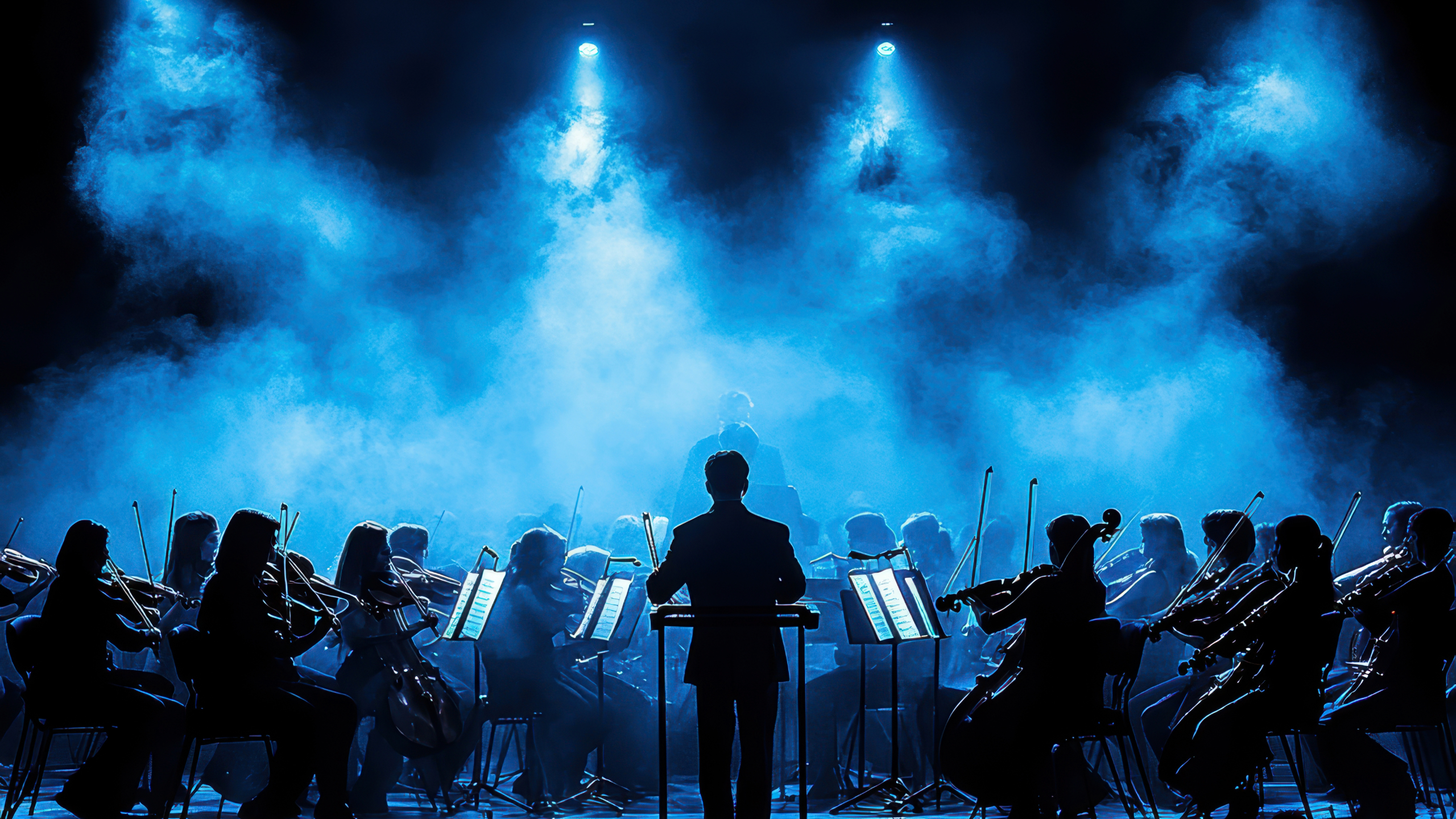
Tomorrow night, the Central Texas Philharmonic will step into a world where cinema and symphonic storytelling meet. Inside Southwestern University’s Alma Thomas Theater, Maestro Stefan Sanders will raise his baton and bring the 1925 silent film The Phantom of the Opera to life — not through dialogue or recorded soundtrack, but through the living, breathing force of a live orchestra.

It’s a performance that reaches back a hundred years, to a time when movie houses relied on musicians to supply the emotional heartbeat of every frame. Silent films had no recorded sound at all — no dialogue, no effects, not even music. The drama on screen depended entirely on the musicians in the pit. Tomorrow, the Philharmonic revives that tradition with a score arranged by composer Peter B. Kaye, a friend of Sanders and a scholar of early‑20th‑century music.
Kaye’s score is a tapestry of works written before 1925, many drawn from the operatic world that shaped Gaston Leroux’s original 1910 novel. Audiences will hear music from Charles Gounod’s Faust — fitting, since the opera appears within the film itself — along with ballet selections and other operatic gems that would have echoed through the Paris Opera House during the Phantom’s fictional reign.
Sanders has spent weeks preparing not only the music, but the film itself. His conductor’s score is filled with handwritten visual cues — moments when Lon Chaney’s Phantom emerges from the shadows, when Christine turns, when the camera sweeps across the opera house. “I’m learning the film as much as I’m learning the music,” he says. “The orchestra has to be perfectly aligned with what’s happening on screen.”
The film has been edited to a tight, one‑hour presentation: no intermission, no pause, just a concentrated burst of gothic romance and orchestral color. It’s a rare chance to experience silent cinema the way audiences once did — with musicians shaping every moment in real time.
🎃 A Halloween Symphony: Psycho, Danse macabre, and Berlioz’s Fantastique
The Philharmonic returns Sunday, October 18, with the full orchestra on stage at Klett Auditorium for a Halloween‑themed program that dives headfirst into the supernatural.

The evening opens with Bernard Herrmann’s suite from Psycho, a score written entirely for strings. Without brass, winds, or percussion, Herrmann had to rely on the raw tension of bow against string — and the result is one of the most anxiety‑inducing sound worlds ever created for film. Sanders calls it “masterful,” noting how Herrmann’s restraint becomes the source of the music’s terror.
Next comes Camille Saint‑Saëns’ mischievous Danse macabre, written in 1874. At the stroke of midnight, the devil draws his bow across the violin, summoning skeletons, spirits, and goblins to dance until dawn. The piece has appeared in countless films and television shows, instantly recognizable for its eerie charm.
The night culminates in Hector Berlioz’s Symphonie Fantastique — a 50‑minute epic of obsession, hallucination, and the macabre. Berlioz, inspired by his infatuation with Shakespearean actress Harriet Smithson, created a five‑movement journey through dreams, ballroom waltzes, pastoral reflection, execution by guillotine, and a final witches’ sabbath filled with bells, bones, and the ancient chant of the Dies Irae.
What makes the work revolutionary is its use of a recurring melody — the “idée fixe” — representing the artist’s unrequited love. It appears in every movement, transformed by the protagonist’s shifting emotional and psychological state. Sanders calls the piece “one of the greatest works of art ever created,” and says hearing it live is essential: “You feel the drama in your bones.”
🌟 A Season Expanding Across Central Texas
The Philharmonic’s reach extends far beyond Georgetown. Sanders explains that the organization chose the name Central Texas Philharmonic deliberately — to reflect a regional identity rather than a single city. The orchestra performs not only at Alma Thomas Theater and Klett Auditorium, but also at Bass Concert Hall on the UT Austin campus, collaborating with artists across genres.
This season includes several live‑to‑picture performances:
- A.R. Rahman on October 27 — the Oscar‑winning composer of Slumdog Millionaire.
- The Muppet Christmas Carol on December 22.
- Wicked (Part I) in February.
- La La Land on Valentine’s Day, with performances in San Antonio and Sugar Land.
More announcements are on the way, Sanders says — projects still under wraps but already generating excitement behind the scenes.
🎟️ Where to Go for Tickets and Information
Tickets and full season details are available at www.centraltexasphilharmonic.org, where audiences can explore upcoming concerts, learn about the orchestra, and connect with the organization.