
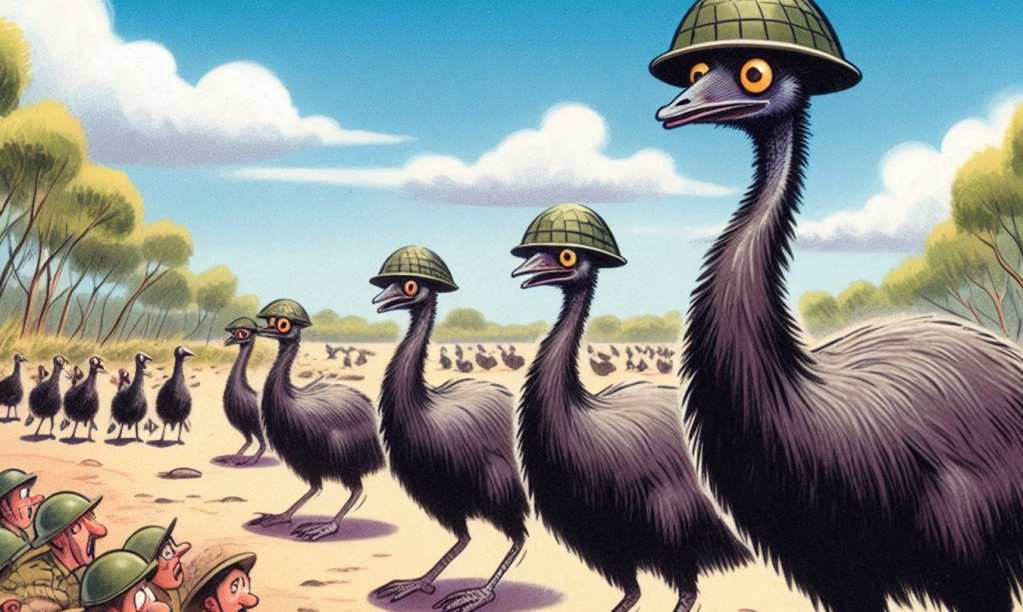
Once upon a time in the early 1930s, Australia faced an unexpected adversary in the form of emus. Yes, that’s right, emus—those sizable flightless birds that are native to the country.
After World War I, many Australian soldiers were given farmland to help rebuild their lives. However, when the Great Depression hit, farming conditions became extremely tough. To make matters worse, approximately 20,000 emus migrated from inland to the coast in search of food and habitat, devastating the crops that farmers depended on for survival.
Seeing the severity of the situation, the farmers turned to the government for help, and the military was called in for what would become known as the Great Emu War. The soldiers, armed with machine guns, expected to make quick work of the emu invasion. They soon found out, however, that the emus were more formidable foes than anticipated. On November 2, 1932, the soldiers first encountered a thousand-strong flock of emus. They opened fire, but these agile birds quickly scattered in all directions. The emus were remarkably resilient, and many simply ran too fast to be caught in the line of fire. The operation was far from the decisive victory the government had hoped for.
Over the next several days, the soldiers tried different tactics. They mounted their machine guns on trucks, hoping to chase down the flocks more effectively. This too was largely unsuccessful, as the rough terrain made operating the weapons difficult, and the emus proved exceedingly adept at evading capture.
By December 10, 1932, after several weeks of “battle,” the government called off the operation. Despite using over 2,500 rounds of ammunition, the military had only managed to kill about a thousand emus, leading to a staggering cost in resources and manpower for very little gain. The emus, it seemed, had outsmarted their human adversaries and continued to roam the farmland.

The Great Emu War remains a quirky chapter in Australia’s history, showcasing a strange blend of human ingenuity and nature’s resilience. While it ended in a so-called victory for the emus, it also served as a reminder of the unforeseen challenges that can arise when dealing with wildlife.
So, next time you encounter an emu, remember—they hold a unique place in history as formidable foes in one of the quirkiest “wars” ever fought.



 KNCT
KNCT 