
A new episode of On the Dock with Rick Smith airs every Wednesday and Friday at 6:15pm on KNCT.
Good News!
Recent rainfall has brought up the water levels for lakes in our area.
- Lake Belton up 4 feet.
- Stillhouse up 3 feet.
- Lake Georgetown up to only 20 feet below normal.
- Buchanan up to 26.5 feet below normal.
- Lake Travis is at 49 feet below normal, which is normal for this time of year.
- Lake Waco is at normal conservation level.
- Lake Whitney at 1.32 feet below normal.
Texas Parks and Wildlife Department, Commission Thank Texans for Approving Prop 14

AUSTIN— Ballots have been tallied from election day and voters have made it clear— state parks matter to the people of Texas. Proposition 14, which creates the Centennial Parks Conservation Fund, passed with overwhelming support from Texas voters.
The fund is made from a portion of state budget surplus and creates a dedicated funding stream for acquiring and developing state parks.
“Today marks the beginning of a new chapter for Texas State Parks thanks to the unwavering support from the Texans who voted to adopt Proposition 14,” said David Yoskowitz, Ph.D., Executive Director of the Texas Parks and Wildlife Department. “This historic vote confirms the value Texans place on conserving outdoor spaces for the enjoyment of all Texans.
“We are grateful for devoted advocates like Texas Coalition for State Parks for their continued support of this important legislation,” added Yoskowitz. “I also want to thank the Texas Legislature – especially Chairman Greg Bonnen, Chairwoman Joan Huffman, Senators Tan Parker, César J. Blanco, Sarah Eckhardt, Lois W. Kolkhorst and José Menéndez, and Representatives Armando Walle, Ken King and Justin Holland– for making this a priority and putting the amendment on the ballot. Thank you for helping us protect future spaces to hike, bike, swim and conserve the natural heritage of Texas.”
“The Texas Parks and Wildlife Commission extends its deepest gratitude to the people of Texas for voting to approve Proposition 14, which invests in the future extension of the state parks system,” said Texas Parks and Wildlife Commission Chairman Jeffery D. Hildebrand. “The passing of this amendment allows the department to make significant strides towards building out a best-in-class system of state managed parks for future generations of Texans to enjoy.
“On behalf of the TPW Commission and the more than 3,200 employees at TPWD,” added Hildebrand, “I want to thank Gov. Greg Abbott, Lt. Gov. Dan Patrick, Speaker Dade Phelan and the countless supporters who have volunteered their time to help inform the public about this important proposition.”
Texas State Parks is celebrating its 100th birthday in 2023 and currently comprises 89 parks, natural areas and historic sites visited by nearly 10 million people every year. In a state where less than five percent of land is available for public enjoyment, Texas State Parks provide an opportunity to more than 30 million Texans (and growing) to spend time outside fishing, taking a stroll or sleeping under the stars.
“The Centennial Parks Conservation Fund is the largest investment in parks in our state’s history and will help usher in a new golden age in time for our bicentennial,” said Rodney Franklin, Director of Texas State Parks. “Now with secured funding for land acquisitions, we look forward to conserving more of Texas’ unique landscape and creating more state parks and memories for the next generation.”
For more information on the Centennial Parks Conservation Fund, visit the Prop 14 webpage on the TPWD website.
Migrating Whooping Cranes Arrive on Texas Coast
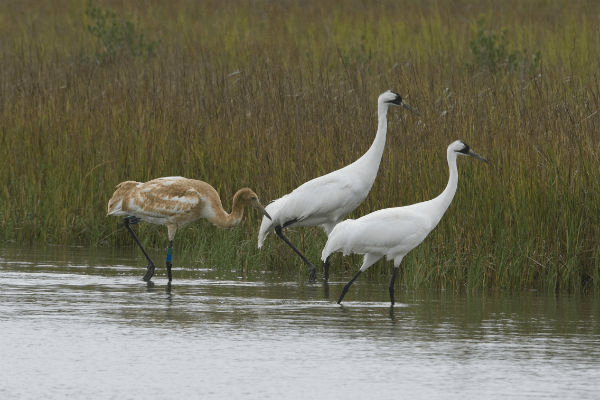
AUSTIN – On November 1, the first pair of whooping cranes of the year were spotted flying toward the Aransas National Wildlife Refuge on the southwest side of San Antonio Bay. Their arrival is about 10 days later than last year, but well within the typical arrival window, according to Kevin McAbee, U.S. Fish and Wildlife Service Whooping Crane Coordinator.
“It is always exciting when the first whooping cranes complete their fall migration and arrive in Texas,” said McAbee. “Flying during the day and resting at night, they have worked hard to reach their winter home in coastal Texas.”
As the iconic birds continue making their way across the state on their way to the coast, the Texas Parks and Wildlife Department (TPWD) reminds Texans to be on the lookout for this endangered species.
“Whooping cranes have spent all summer nesting and raising chicks in and around Wood Buffalo National Park in northern Canada,” said McAbee. “Now they are completing the approximately 2,500-mile journey south to their wintering grounds in Texas, a migration that can take up to 50 days.”
During their migration, whooping cranes seek out wetlands and agricultural fields where they can roost and feed. The birds often pass large urban centers like Dallas-Fort Worth, Waco and Austin. Though whooping cranes rarely stay in one place for more than a day during migration, it is important that they not be disturbed or harassed at these stopovers. As a federally protected species, it is illegal to disturb or harass these birds.
Habitat Conditions
The conditions whooping cranes experienced in their summer nesting area in Canada are relatively similar to what they will find when they reach coastal wintering grounds. Drought and wildfire conditions through the summer degraded habitat quality, with thick smoke and dry wetlands throughout the nesting and rearing period.
“Luckily, most whooping cranes and nests were not directly impacted by fires,” said McAbee. “While these conditions may reduce the number of juvenile cranes that will arrive in Texas this year, we expect overall numbers to be similar to the estimated 540 whooping cranes that inhabited coastal Texas last year.”
Drought conditions are something the birds will have to contend with in their winter habitat, according to the U.S. Drought Monitor. Bay salinities are high following a dry summer, causing whooping cranes to be more likely to use freshwater habitats and new areas, some of which are more inland than previous years.
Mistaken Identity
The increasingly common use of inland areas by whooping cranes is a concern for conservationists, as these areas overlap with sandhill crane and other waterfowl habitats as well as hunting seasons.
TPWD urges hunters to take extra caution and be sure of bird species before taking a shot. Just because hunters are away from the Texas coast, doesn’t mean the bird in question is not a whooping crane. Cases of mistaken identity can happen, something that can be detrimental to the tallest and rarest species of bird in North America.
Whooping cranes are sometimes found in mixed flocks with sandhill cranes, which are gray and slightly smaller. With their all-white body plumage and black wingtips, whooping cranes may also resemble snow geese, which are much smaller and have faster wing beats. A video detailing the differences between snow geese and whooping cranes can be found on the TPWD YouTube Channel.
There are several other non-game species that are similar in appearance such as wood storks, American white pelicans, great egrets and others, but a close look will reveal obvious differences. More information on look-alike species is available online.
Thanks to coordinated conservation efforts, these endangered birds are slowly returning from the brink of extinction.
Whooper Watch
The public can help track whooping cranes by reporting sightings to TPWD’s Texas Nature Trackers’ (TNT) Texas Whooper Watch, a citizen science-based reporting system that tracks whooping crane migration and wintering locations throughout Texas. For more information, visit the website to learn more about the program and download the iNaturalist mobile app to get started.
These observations help biologists identify new migration and wintering locations and their associated habitats. Questions about Texas Whooper Watch and other TNT programs that contribute to TPWD’s research and conservation efforts can be directed to TNT staff at tracker@tpwd.texas.gov.
Biologists remain optimistic that continued research and restoration work will ultimately lead to improved numbers of whooping cranes and say that new pending federal legislation, the Recovering America’s Wildlife Act (RAWA), could help in a big way. RAWA would provide the funding needed to continue the important conservation work that is vital for whooping cranes and other species throughout Texas. Learn how to help through the Texas Alliance for America’s Fish and Wildlife online toolkit. Texas Wildlife Alliance is a grass roots coalition formed to support RAWA.



 KNCT
KNCT 