
As Halloween approaches, images of scary bats become commonplace.

Which is why this is perfect time of year to counter bat myths and do something to help bats, by taking part in International Bat Week, beginning next Tuesday through the end of the month.
Bat Week is all about appreciating these amazing animals and their benefits, including eating insects, pollinating flowers, and spreading seeds and nutrients.
According to Texas Parks & Wildlife Department, Texas happens to be the battiest state in the country. It is home to 32 of the 47 species of bats found in the United States. Not only does it hold the distinction of having the most kinds of bats, it also boasts the largest known bat colony in the world, Bracken Cave Preserve, near San Antonio, and the largest urban bat colony, Congress Avenue Bridge, in Austin.
Mexican free-tailed bats (also known as Brazilian free-tailed bats) are the most common bat found throughout Texas. In most parts of the state, Mexican free-tailed bats are migratory and spend the winters in caves in Mexico. They begin their migration to Texas in February and by early spring female bats form large maternity colonies where they will raise their young. There are only a small number of suitable sites for these large maternity colonies because the bats require high humidity and temperature levels. In June, mother bats give birth to one pup each. Male bats do not help in raising the young and form smaller “bachelor” colonies away from females.
It is estimated that baby Mexican free-tailed bats roost in densities of up to 500 pups per square foot. It is amazing to think that mother bats are able to find their own baby amongst thousands of pups by using their sense of smell and by knowing the sound of their pup’s call.
By early August, most pups are flying and foraging on their own. It is at this time of the summer when the most spectacular bat emergences often occur as the colony size might easily double. When the first cold fronts start pushing through in late October to mid-November, the Mexican free-tailed bats begin their migration to Mexico for the winter.
Viewing a bat emergence is one of the most memorable and exciting experiences in nature. Realize that a bat emergence is not a predictable event. No one can be sure when bats will come out or if they will even come out at all. Bad weather, cold temperatures, and other factors can cause bats to vary their emergence times.
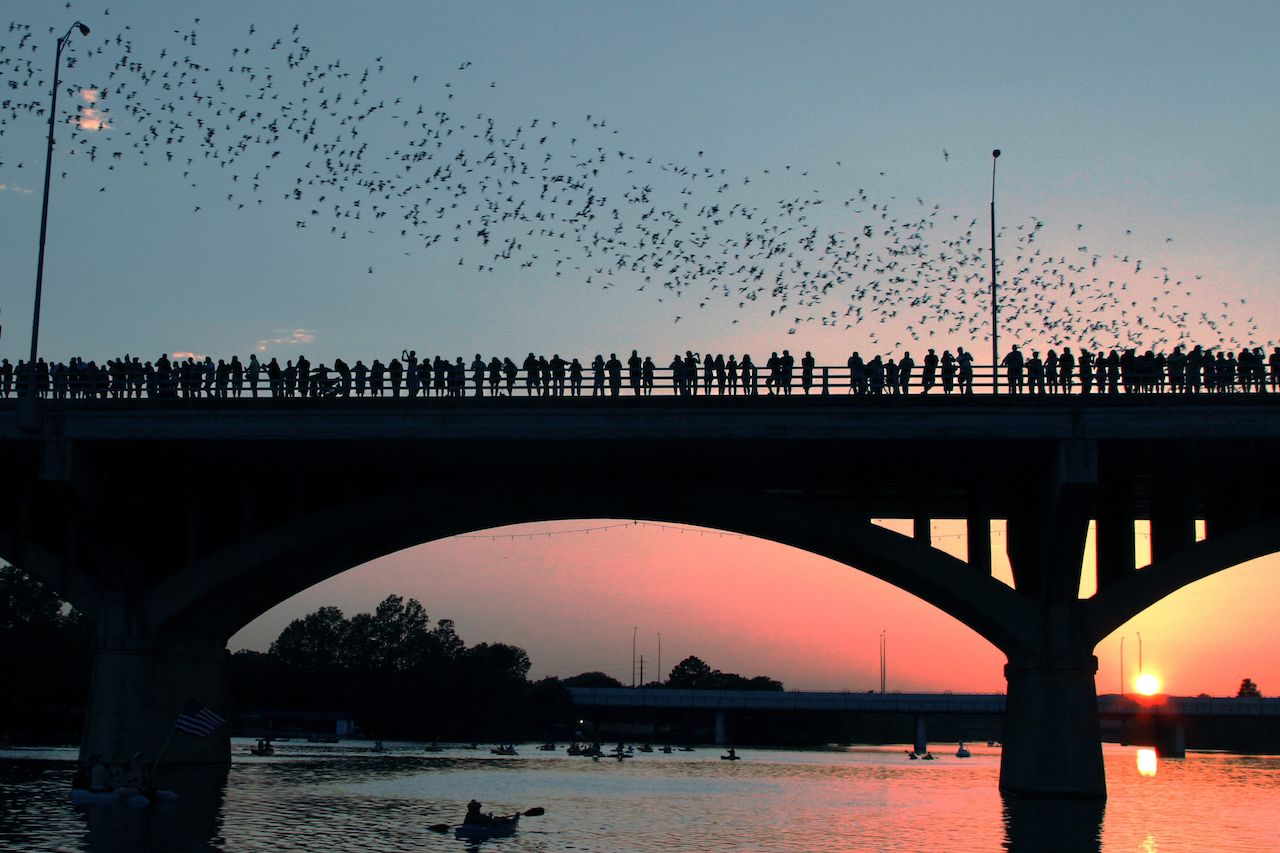
The Ann W. Richards Congress Avenue Bridge, located in the heart of downtown Austin, hosts the largest urban bat colony in the world, estimated at 1.5 million bats. It is a maternity colony, and mother Mexican free-tailed bats raise an estimated 750,000 pups each year at the bridge. Large numbers of bats began roosting in the Congress Avenue Bridge in the early 1980s, shortly after it was renovated. Few people understood how valuable the bats were, and many feared them. It took a lot of effort by Bat Conservation International and other bat-friendly folks to help turn the tide of public opinion. Today, Austin loves its bats, and this international tourist attraction brings 140,000 people and as much as $10 million to Austin every year!
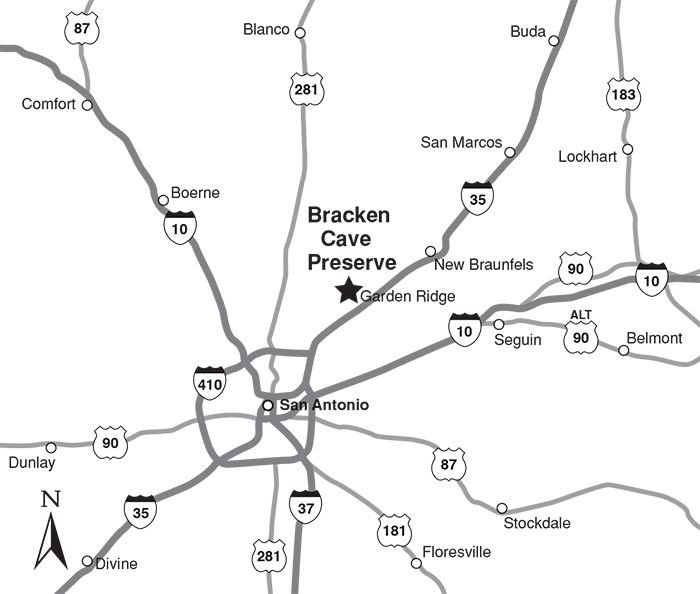
Bracken Cave, on the northern outskirts of San Antonio, is home to the world’s largest bat colony, with more than 15 million Mexican free-tailed bats. It is a key maternity site for this species, and females congregate there each year to give birth and rear their young. Mexican free-tailed bats are an essential predator of corn earworm moths and other crop pests, and the Bracken colony alone is estimated to consume over 100 tons of these moths every summer night. Bat Conservation International (BCI) initially purchased the Bracken Cave in 1991 and now owns nearly 1,500 acres of the former ranch land surrounding the cave. Although the land lost some of its original plant and animal diversity as a result of ranching and other commercial uses, it is being managed as a nature preserve and is home to many bird species, including endangered golden-cheeked warblers.
When it comes to bat-watching, here is some etiquette to keep in mind.
Keep your distance from the bats while they are emerging. Most viewing sites have designated seating areas where you can view the bats comfortably out of the direct flight path of the bats. If viewing bats emerging from a bridge, avoid standing directly beneath the bridge and move to the side instead. Giving bats the space to fly minimizes disturbance to the bats and avoids any collisions.
It is important to keep your voices low while viewing a bat flight. Loud noises can disturb the bats and cause them to alter their emergence behavior.
Please do not shine any type of light at the bats, including cellphone lights or the flash on your camera. This unexpected light disturbs the bats and may alter their emergence behavior and facilitate capture by predators.
If you happen to find a bat on the ground, DO NOT TOUCH IT! For the safety of the bats and yourself, give the bat space and avoid contact. The bat could be a youngster learning to fly or an ill bat. Wild animals may bite when threatened. Bats, like other mammals, can contract rabies, but the vast majority do not. Please never touch or handle a bat. Notify the site’s manager or volunteer or call a local animal control office.
Here is some interesting bat facts:
Texas bats can be found in caves, cliff crevices, bridges, tree foliage, snags, hollow trees, and increasingly, as their habitat is lost, in buildings. Contrary to old myths, bats are not blind, will not get tangled in your hair, and are not flying rodents.
Bats are adapted for hanging upside down. Their hind limbs are rotated 180 degrees so that their knees face backwards. They hang by their legs and use the claws on their toes to support their weight. Locking tendons in the toes allow the bats to hang without expending energy
Bats are incredibly long-lived for their size, with the oldest confirmed insectivorous bat living 41 years!
Some bats are important pollinators and seed dispersers. Many of our everyday products, such as tequila, wild bananas, balsa wood, and allspice to name a few, come from bat pollinator-dependent plants. One of our Texas bats — the pallid bat — feeds on centipedes and scorpions crawling on the desert floor, and it is immune to their venom!
Learn how bats impact conservation in Texas, and how you can help house them by building a bat house. Visit Bat Conservation International at batcon.org.

To learn more about the Cen-Tex Sustainable Communities Partnership and for local event updates, check out our Facebook page Centex Sustains. Feel free to send questions and topic suggestions for this show to centexsustains@gmail.com. Join us each week on Monday at 6:15 pm on KNCT-FM 91.3 to learn more about environmental and sustainable practices.


 KNCT
KNCT 