
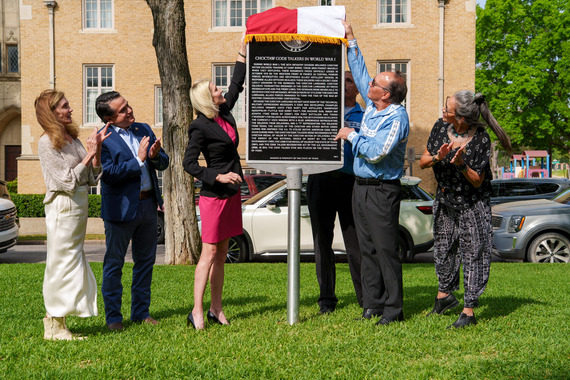
A powerful new chapter in Texas and American military history was recognized April 1 in Fort Worth, where a Texas Historical Commission marker was dedicated at Veterans Memorial Park to honor the Choctaw Code Talkers — the soldiers of the 36th Infantry Division whose use of their Native language helped secure Allied victory on the Western Front during World War I.

The ceremony brought together leaders from the Choctaw Nation of Oklahoma, the 56th Infantry Brigade Combat Team, the City of Fort Worth, and the Texas Historical Commission. The setting itself carried deep significance: Veterans Memorial Park sits on the former grounds of Camp Bowie, the sprawling World War I training installation where Choctaw soldiers prepared for deployment before shipping out to France in 1918.
On the battlefields of Europe, Allied forces faced a dire challenge. German units were intercepting and decoding radio and telephone communications with alarming accuracy, turning the Allies’ own messages into vulnerabilities. Embedded within the 36th Infantry Division, a group of Choctaw soldiers offered a solution no military cryptographer could have devised — their own language. Unfamiliar to German intelligence and unwritten at the time, the Choctaw language became an unbreakable communication tool. These men formed what became known as the “Choctaw Telephone Squad,” transmitting tactical messages that helped shift momentum during the Meuse‑Argonne Offensive, particularly at the Battle of Blanc Mont Ridge. Their efforts contributed to breaching the Hindenburg Line in the final weeks of the war.
“This marker is a doorway to a chapter of Texas and American history that defines the spirit of our state,” said Texas Historical Commissioner Catherine McKnight. “Though many of these men were not Texans by birth, they became part of the fabric of our National Guard. Their ingenuity and bravery remind us of the power of cultural heritage.”
For many families, the story of the Code Talkers remained hidden for generations. During the ceremony, Nuchi Nashoba — President of the Choctaw Code Talkers Association and great‑granddaughter of Code Talker Ben Carterby — shared her personal journey of uncovering a legacy long kept quiet. Like many Native veterans of the era, Carterby rarely spoke of his wartime role, even to those closest to him.
Choctaw Nation Chief Gary Batton reflected on the profound contradictions of the era. “It was a time when our people could not even vote; we were not even recognized as citizens,” he said. “But our people stepped up for the greater good. To us, it wasn’t a ‘code’ — it was our language and our culture being used to do the right thing for God and country.”
The new marker stands at 4120 Camp Bowie Boulevard, marking the area where more than 100,000 soldiers once trained for service overseas — including the Choctaw men who integrated into the 142nd Infantry Regiment and helped change the course of the war. The marker text, developed in collaboration with Choctaw Nation representatives, joins other monuments at the site honoring the camp, its trainees, and their service and sacrifice — whether the nation recognized them at the time or not.
The Choctaw Code Talkers’ legacy continued long after World War I. Their success inspired the use of Native American languages again during World War II, and their contributions have since been recognized with honors including the Choctaw Medal of Valor (1986), the French National Order of Merit (1989), the Lone Star Medal of Valor (2007), and the U.S. Code Talker Recognition Act (2008). In 2010, the Code Talker Star was added to the Texas Trail of Fame.
The Texas Historical Commission’s marker program — now numbering more than 17,000 markers statewide — helps preserve stories like these, adding depth and texture to the state’s shared heritage.



Join the conversation