
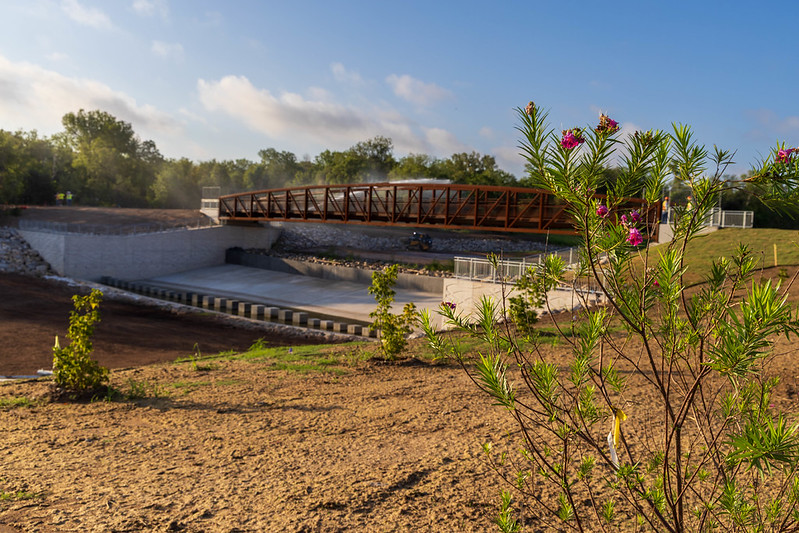
Austin has completed a milestone effort at Roy G. Guerrero Colorado River Metropolitan Park, wrapping up the largest erosion‑control project in the city’s history. The $28.5 million undertaking marks a turning point for a stretch of parkland that has faced years of instability, repeated flooding, and the loss of hundreds of mature trees.
The work focused on the Country Club West creek, where severe flooding in 2015 washed out the pedestrian bridge and carved away at the banks. That erosion threatened far more than trails—it put Krieg Fields, nearby homes, major water and wastewater lines, and key roadways like Riverside Drive and Wickersham Lane at risk.
The newly opened pedestrian bridge now stands as a symbol of the park’s renewal. Built to withstand future flood events, it crosses one of three new grade‑control structures designed to safely guide stormwater from the creek down to the Colorado River. Crews also restored a naturalized river bottom and reinforced the channel with rock and native grasses to stabilize the banks.
Restoration extended beyond the waterway. The City planted more than 40 new trees within the project area and invested an additional $500,000 to reforest the broader park, helping to replace the canopy lost to years of erosion. Funding came from Drainage Utility Funds, the 2018 Bond Program, and a FEMA Hazard Mitigation Grant.
Jorge Morales, Director of Austin Watershed Protection, said the project represents a shift toward smarter, more resilient infrastructure. “This project shows how thoughtful engineering, collaboration and innovation can correct the mistakes of the past. It protects our open spaces, improves park connectivity, enhances wildlife habitat, and helps build a more resilient Austin for the future.”
Mayor Kirk Watson emphasized the broader impact. “This project is about more than erosion control—it’s about protecting homes, infrastructure, and natural spaces while strengthening Austin’s flood resilience. Thanks to FEMA, Austin voters, and local partners, we’ve stabilized 35 acres of parkland and strengthened Austin’s resilience to flooding.”
The effort is already earning recognition. The Texas chapter of the American Public Works Association named it the 2025 Project of the Year in the Environmental Projects category for work between $25 and $75 million—a statewide nod to the scale, complexity, and community value of the restoration.
If you want to shape this into a radio script or a shorter web version, I can help refine it.



 KNCT
KNCT 
Leave a comment