
AUSTIN, Texas — In a significant step toward environmental stewardship, the U.S. Fish and Wildlife Service has published the final recovery plan for seven federally protected species residing in the Edwards Aquifer. These species—found only in Central and South Texas—are listed as endangered or threatened under the Endangered Species Act (ESA) and depend on the vital spring systems of Comal and San Marcos springs for survival.
The recovery plan outlines a path forward to protect these species so they may one day thrive without ESA protections. It includes strategic actions designed to preserve, restore, and manage their aquatic habitats while ensuring the Edwards Aquifer continues to sustain both wildlife and human communities.
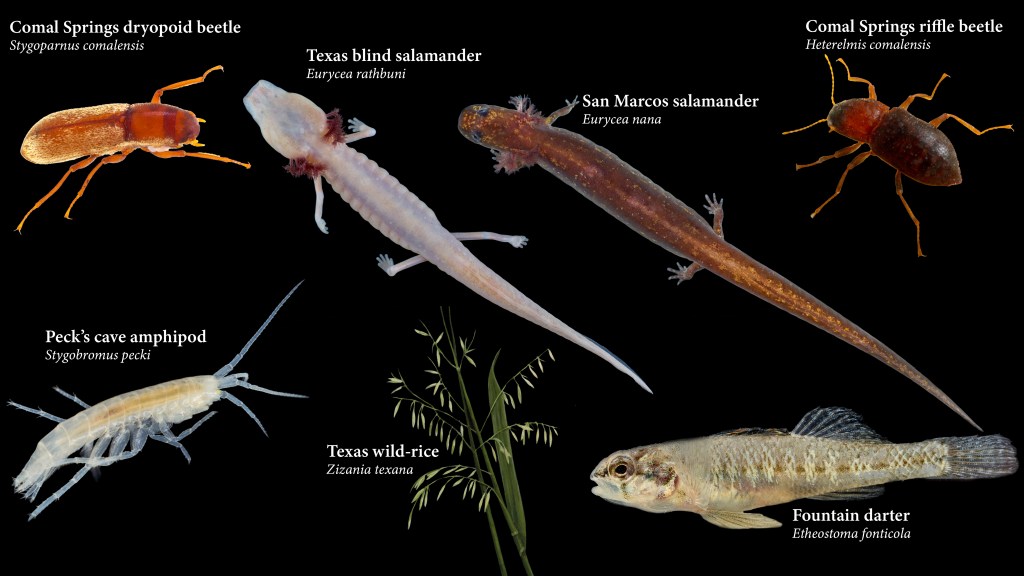
The southern Edwards Aquifer is recognized for its remarkable biodiversity, serving as the sole habitat for these species:
- Texas wild-rice (endangered) — A rare aquatic plant
- Comal Springs dryopid beetle (endangered) — A small orange beetle
- Comal Springs riffle beetle (endangered) — A reddish beetle that thrives in spring waters
- Fountain darter (endangered) — A small, vividly colored fish
- Peck’s cave amphipod (endangered) — A translucent crustacean
- Texas blind salamander (endangered) — A striking pink-clear amphibian
- San Marcos salamander (threatened) — A tan-orange aquatic salamander
All seven species rely on the continuous flow of groundwater from the Edwards Aquifer, but rapid urban development poses a serious threat to their survival. Diminishing water quality and quantity, alongside habitat degradation, make conservation efforts more urgent than ever.
To safeguard these species, the plan focuses on habitat restoration, water resource management, and captive refugia—backup populations raised in controlled environments to prevent catastrophic losses. Cooperation among federal, state, and local agencies, as well as private entities, will be essential for success.
While recovery plans are not legally binding, they serve as essential blueprints for collaboration. The finalized plan lays out the necessary conservation measures, delisting criteria, and estimated timelines and costs associated with restoring these species to sustainable levels.
For more details, visit their website or contact the U.S. Fish and Wildlife Service’s Austin Ecological Services Field Office.




 KNCT
KNCT 