
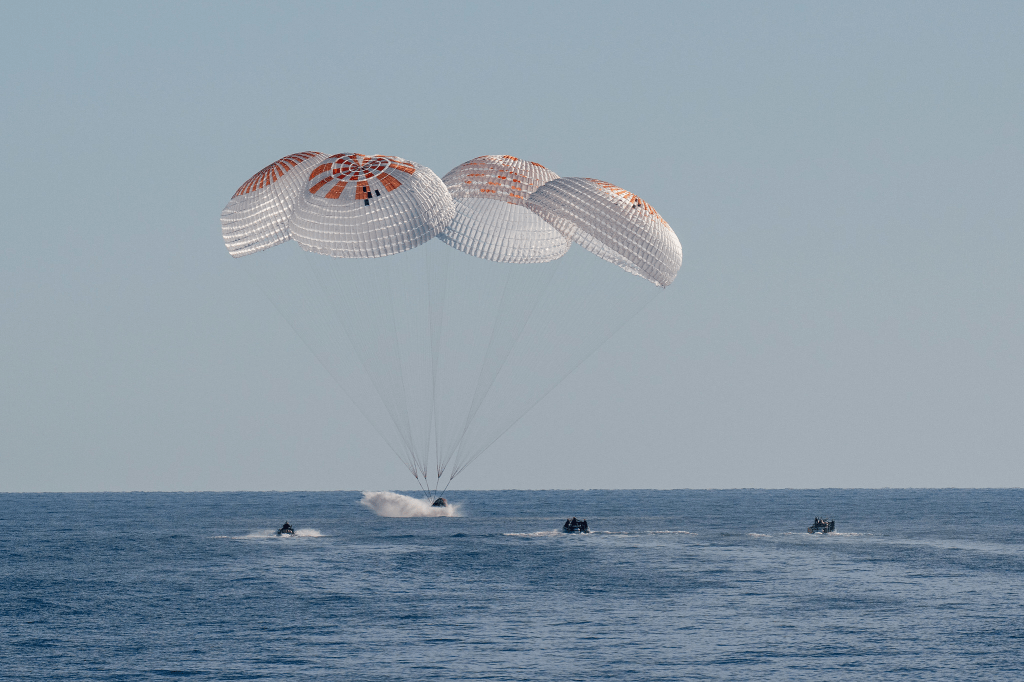

NASA’s SpaceX Crew-9 mission concluded successfully on March 18, 2025, as the spacecraft splashed down in the Gulf of Mexico near Tallahassee, Florida. The international crew—NASA astronauts Nick Hague, Suni Williams, and Butch Wilmore, along with Roscosmos cosmonaut Aleksandr Gorbunov—returned after conducting critical science and technology activities aboard the International Space Station (ISS).
Throughout their mission, the Crew-9 team engaged in more than 150 unique experiments and technology demonstrations, accumulating over 900 hours of research. Their studies spanned various scientific disciplines, including plant biology, stem cell research, and astronaut health. Key experiments involved investigations into:
- Plant Growth and Quality: Aimed at improving food production methods for future deep-space missions.
- Stem Cell Technology: Focused on the potential applications for treating blood diseases, autoimmune disorders, and cancer.
- Circadian Rhythm Adaptation: Testing lighting systems to support astronauts’ sleep cycles and overall health during long-duration spaceflights.
The team also contributed to innovative technology by deploying the first wooden satellite, studying the resilience of microorganisms in space, and collecting samples from the station’s exterior for microbial analysis.
Suni Williams, a veteran astronaut, conducted two spacewalks—setting a record for the most total spacewalking time by a female astronaut at 62 hours and 6 minutes. Joined by Nick Hague and Butch Wilmore, she performed essential maintenance tasks, including removing a radio frequency group antenna assembly, collecting samples from the station’s external surfaces, and repairing components on an X-ray telescope.
In total, Crew-9 traveled millions of miles and completed thousands of Earth orbits during their mission. The spacecraft used for their return, a SpaceX Dragon named Freedom, will now undergo inspection and refurbishment at SpaceX facilities.
As part of NASA’s Commercial Crew Program, Crew-9’s mission highlights the agency’s commitment to safe and cost-effective transportation to the ISS. By enabling extensive research and testing in a microgravity environment, the program serves as a foundation for future human exploration of the Moon and Mars.




 KNCT
KNCT 